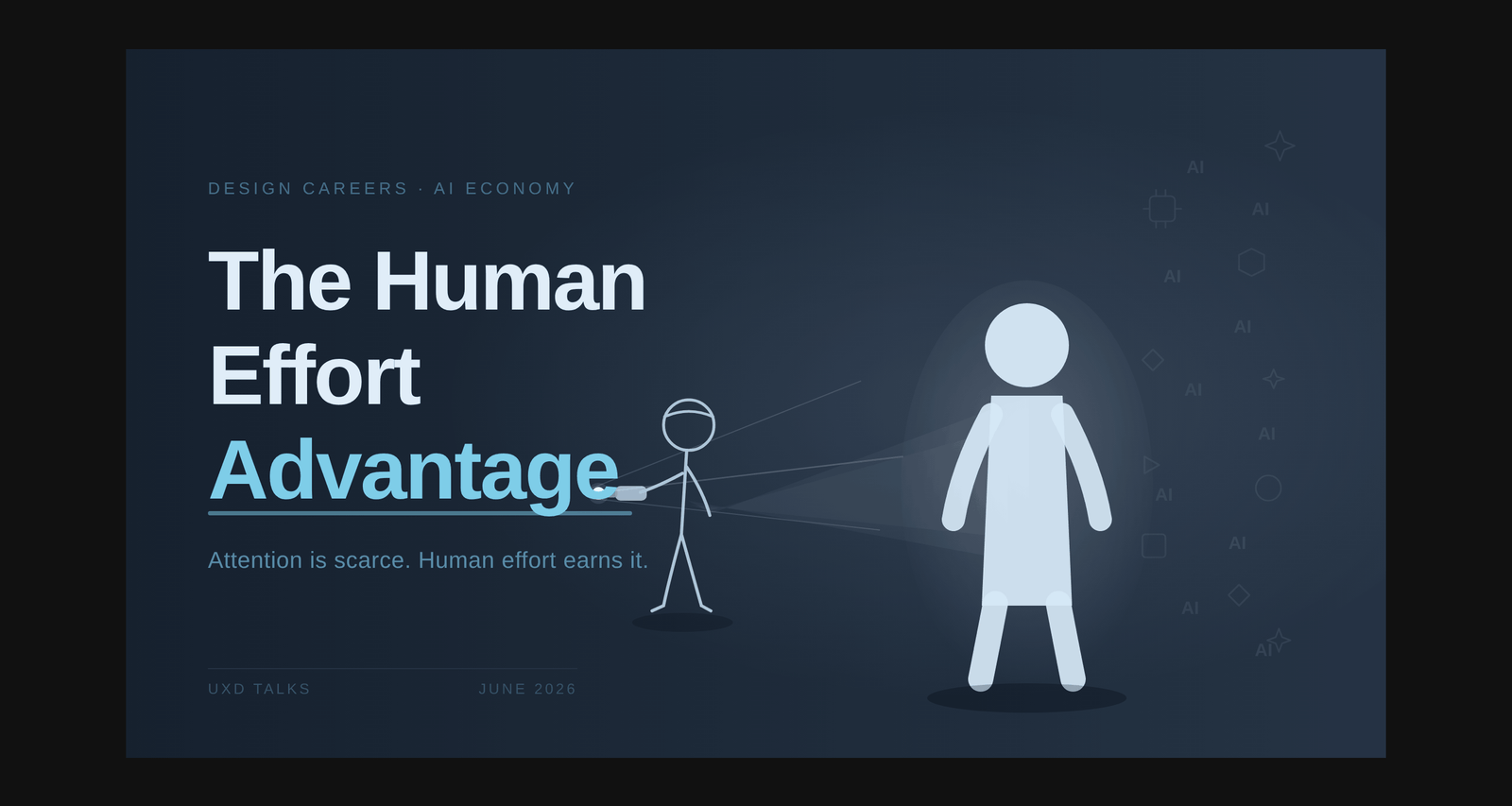
The Human Effort Advantage: What the AI Attention Economy Means for Designers' Careers
"If you are asking for someone's attention, you should demonstrate human effort." — Tom Bedor, If You Are Asking for Human Attention, Demonstrate Human Effort (1,473 points on Hacker News, June 2026)
A 1,473-Point Wake-Up Call
On June 11, 2026, a relatively obscure blog post from developer Tom Bedor hit the front page of Hacker News and didn't leave. It accumulated 1,473 points and 455 comments in under 24 hours — making it one of the most viral posts on the platform this year.
The thesis is deceptively simple: in a world where AI can generate infinite content, the scarce resource is human attention — and the only credible way to earn it is by demonstrating genuine human effort.
For UX designers, this isn't just a philosophical observation. It's a career strategy framework. Because the same dynamic Tom describes in the content world is now playing out in design hiring, portfolio evaluation, and team structure — and most designers aren't paying attention.
Here's what's actually happening, why it matters for your career in 2026, and what to do about it.
The Attention Scarcity Problem (And Why AI Made It Worse)
Let's start with the economic reality.
The design industry has always operated on a supply-demand model. Good designers were scarce. Portfolios were hard to fake. The effort required to produce polished work was itself a quality signal.
AI broke that signal.
When a junior designer can generate 47 dashboard variations in an hour using Figma Make, when a single prompt in Cursor can produce a functional prototype, when AI agents can now design directly on the Figma canvas (as Figma announced in May 2026 with their Design Agent launch) — the effort barrier that once separated professionals from amateurs has collapsed.
The result? Attention inflation. Recruiters are drowning in portfolios that all look equally polished. Clients can't distinguish between work that took 40 hours of research and iteration and work that took 40 seconds of prompting. Hiring managers report spending less time reviewing portfolios, not more, because the signal-to-noise ratio has degraded so badly.
Tom Bedor's post went viral because it named what everyone was feeling: when everything looks effortless, effort itself becomes the differentiator.
The Three Career Implications Most Designers Are Missing
1. Your Portfolio Is No Longer Proof of Skill — Your Process Is
For years, the design portfolio operated on a simple equation: polished output = skilled designer. That equation is now broken.
In the AI attention economy, the work product is table stakes. What matters is evidence of human judgment — the decisions you made, the tradeoffs you navigated, the research you conducted, the iterations you pursued.
What this means practically:
- Show your messy middle. Include sketches, failed prototypes, research notes, and iteration histories. The mess is the proof of effort.
- Document decision rationale. Don't just show the final design — explain why you chose it over alternatives. AI can generate options; human judgment selects the right one.
- Quantify your impact with context. "Increased conversion by 23%" is a metric. "Increased conversion by 23% after interviewing 14 users, identifying 3 friction points, and iterating through 7 prototypes" is evidence of human effort.
Figma's own Chief Design Officer Loredana Crisan made a related point in her June 8 blog post: "Having the right tools can only take you so far. To become a master of your craft, you need to hone a point of view." The tools are now commoditized. Your point of view — forged through effort — is the asset.
2. The "Effort Premium" Is Reshaping Design Hiring
Here's what I'm seeing in the hiring market, and what the data supports:
Entry-level design roles are contracting. Not disappearing — but the bar is rising. When AI can handle the production work that junior designers used to cut their teeth on, companies need entry-level hires who bring something AI can't: contextual judgment, stakeholder communication, and the ability to navigate ambiguity.
Mid-level designers face a squeeze from both directions. AI tools handle the execution work below; senior designers handle the strategy work above. The mid-level designer who survives is the one who demonstrates effort in the judgment layer — not just the production layer.
Senior and staff-level designers are seeing an "effort premium." The more senior you are, the more your value is tied to decisions that require human context — organizational politics, user empathy, ethical tradeoffs, cross-functional leadership. These are precisely the areas where demonstrated effort (deep research, stakeholder alignment, iterative validation) is most visible and most valued.
A 2026 Figma survey found that designers worldwide are "upleveling their skills, keeping craft high, and turning new pressures into creative momentum." The designers thriving in this environment aren't the ones who resist AI — they're the ones who use AI to amplify their human effort rather than replace it.
3. Team Structures Are Shifting Toward "Effort Density"
The traditional design team model — 1 senior designer, 3 mid-level, 2 junior — was built on a production pipeline. Juniors produced components, mid-levels assembled flows, seniors set direction.
AI is collapsing that pipeline. When one designer with AI tools can produce what used to take three, the question becomes: what do you do with the freed-up capacity?
The answer, forward-thinking teams are discovering, is effort density — redirecting human effort toward the highest-value activities:
- More research, less assumption. Instead of spending 70% of time on production and 30% on research, flip the ratio. Use AI for production acceleration and invest the savings in deeper user understanding.
- More iteration, more validation. Run more cycles. Test with real users more often. The teams that win aren't the ones that ship fastest — they're the ones that learn fastest.
- More cross-functional embedding. Designers who sit with engineers, PMs, and customer success teams develop contextual knowledge that no AI can replicate. This is effort that compounds over time.
The Framework: Human Effort as Career Strategy
I want to propose a framework I'm calling the Effort Allocation Matrix — a way to think about where to invest your limited human effort for maximum career impact.
The Matrix
| Low AI Replaceability | High AI Replaceability | |
|---|---|---|
| High Career Impact | ZONE A: Double Down (Strategy, research, stakeholder leadership) | ZONE B: Leverage AI (Production, prototyping, component design) |
| Low Career Impact | ZONE C: Delegate or Automate (Documentation, handoff specs) | ZONE D: Eliminate (Repetitive production tasks) |
Zone A is where your career is won or lost. These are the activities that require human judgment, organizational context, and empathetic understanding. Invest disproportionately here.
Zone B is where AI is your accelerator. Use Figma Make, Cursor, and AI agents to handle production work — but always with your human judgment directing the output.
Zone C is necessary but not differentiating. Automate where possible, delegate where not.
Zone D is where your career goes to die. If your primary value is executing repetitive production tasks, AI will replace that value. Period.
How to Apply This Today
- Audit your last week. Categorize every task you did into the four zones. If you spent more than 40% of your time in Zones C and D, you have a career risk.
- Reallocate 10 hours this week. Move 10 hours from Zone C/D activities into Zone A. That might mean conducting user interviews instead of polishing specs, or facilitating a cross-functional workshop instead of updating a design system.
- Make your Zone A work visible. Write about your research findings. Present your strategic recommendations. Share your decision frameworks. This is how you demonstrate effort in the attention economy.
What This Means for Design Education (A Note for Students)
If you're a student or early-career designer reading this, the implications are significant:
Don't compete with AI on production. You will lose. The student who can generate 100 screens in Figma Make is not more employable than the student who can conduct a rigorous usability study and synthesize actionable insights.
Build your Zone A muscles now. Take courses in research methods, facilitation, and strategic thinking. Practice stakeholder communication. Learn to navigate ambiguity. These are the skills that will be valuable when you graduate — and they're the skills that take years of deliberate effort to develop.
Your portfolio should read like a decision journal, not a gallery. Show your thinking, not just your output. The hiring managers who matter — the ones at companies building real products for real users — can tell the difference between AI-generated polish and human-earned insight.
At UXD Talks, we've restructured our curriculum around exactly this principle. Our Industry Fit Course now dedicates 60% of session time to research, strategy, and stakeholder skills — because that's where human effort creates the most value.
The Counterargument (And Why It's Wrong)
Some will push back: "If AI gets good enough, won't it eventually handle Zone A too? Won't AI eventually do research synthesis, strategic recommendations, and stakeholder facilitation?"
Maybe. Eventually. But here's why that argument misses the point:
The value isn't in the output — it's in the effort. Even if AI could perfectly synthesize research findings, the act of conducting the research — building rapport with users, observing their environment, noticing the things they don't say — creates organizational knowledge and stakeholder trust that no AI can replicate.
Human effort is a trust signal. When you present research findings to a leadership team, they're not just evaluating your conclusions. They're evaluating whether you did the work — whether you talked to real users, whether you challenged your assumptions, whether you earned your recommendations through effort. That trust is the foundation of design's influence in organizations.
The "messy middle" is where insight lives. AI excels at clean inputs and clean outputs. But the most valuable design insights come from the messy middle — the contradictions, the edge cases, the moments of surprise. Navigating that messiness requires human effort, and the effort itself is what makes the insight credible.
Future Predictions: The Next 18 Months
Based on current trends, here's what I expect to see:
- Portfolio formats will shift dramatically. Within 12 months, the dominant portfolio format will include process documentation, research artifacts, and decision rationale — not just final screens. The "case study" format will evolve from "here's what I made" to "here's how I thought."
- "Effort signals" will become hiring criteria. Expect to see interview questions like "Walk me through a time your initial approach failed and how you pivoted" or "Show me a project where you changed your mind based on evidence." These questions are designed to detect genuine human effort.
- Design teams will shrink in production headcount but grow in research and strategy. The ratio of researchers-to-designers will increase. Teams will have fewer "pixel pushers" and more "judgment holders."
- AI literacy will become a baseline, not a differentiator. Knowing how to use Figma Make or Cursor will be as unremarkable as knowing how to use Photoshop. The differentiator will be what you do with the time AI saves you.
- The "craft premium" will increase. As AI-generated design becomes ubiquitous, hand-crafted, deeply-researched, human-centered design will command a premium — the same way handmade goods command a premium in an era of mass production.
The Bottom Line
The AI attention economy isn't coming — it's here. The designers who thrive won't be the ones who produce the most output, or even the ones who use AI tools the most skillfully. They'll be the ones who invest human effort where it matters most — in research, judgment, strategy, and the messy, unglamorous work of understanding real people and navigating real organizational complexity.
Tom Bedor's viral post wasn't really about content creation. It was about what humans value in other humans. And what we value — what we've always valued — is effort. Not effort for its own sake, but effort as evidence of care, of commitment, of genuine engagement with the problem.
In a world of AI-generated everything, that's your competitive advantage. Use it.
References
- Bedor, T. (2026). If You Are Asking for Human Attention, Demonstrate Human Effort. tombedor.dev. [HN: 1,473 points, 455 comments]
- Crisan, L. (2026). You Never Stop Cultivating Taste. Figma Blog. June 8, 2026.
- Figma. (2026). The Figma Design Agent Is Here. Figma Blog. May 20, 2026.
- Figma. (2026). Figma Make, Now on Your Local Code. Figma Blog. May 28, 2026.
- Figma. (2026). Improving Performance in the Layers Panel. Figma Blog. June 11, 2026.
- Stafford, M. (2026). State of the Designer 2026: Designers Are Leaning into the Messy Middle. Figma Blog. February 12, 2026.
- Yamashita, Y. (2026). What Matters When Anyone Can Build. Figma Blog. May 22, 2026.
- Dean, M. (2026). Steal This Template: Bring a User Persona to Life with Figma Weave. Figma Blog. June 10, 2026.
Published: June 13, 2026 | Author: Nikhil, CAO at UXD Talks | Reading time: 14 min
Was this article helpful?