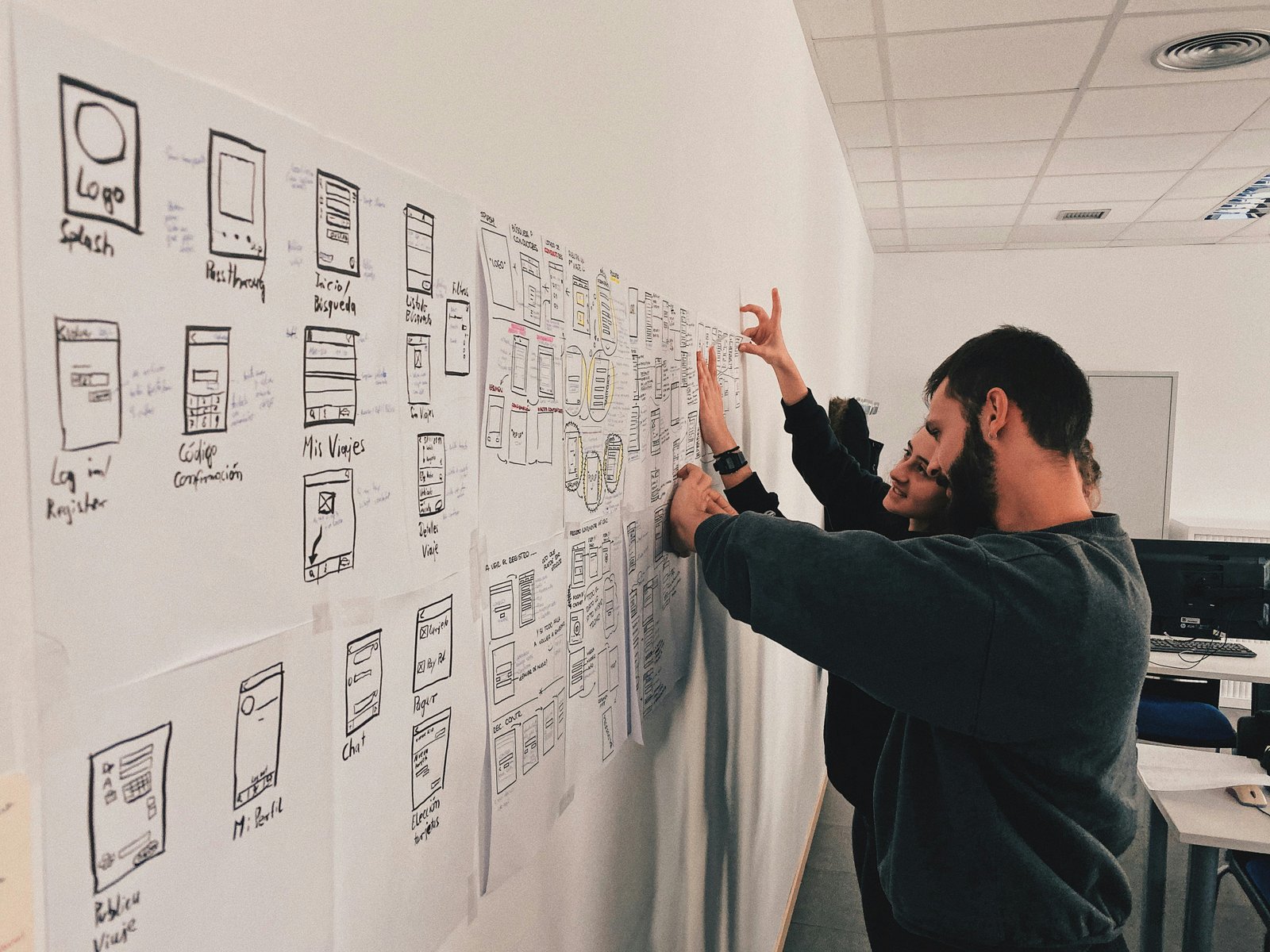
Why the most impactful designers in 2026 are no longer the ones who make the prettiest screens.
There's a quiet revolution happening inside UX teams, and most organizations haven't noticed it yet.
The designers who used to spend their days polishing pixel-perfect interfaces are now facilitating workshops between engineers and AI systems. The researchers who once ran one usability test per week are orchestrating mixed-method programs that blend conversational AI analysis with traditional ethnographic observation. The content strategists who obsess over microcopy are now designing the decision architectures that determine what an AI agent says — and what it chooses not to say.
Welcome to the era of the UX Strategist.
This isn't a reduction in design quality. It's a fundamental expansion of what design leadership means. And if you're still evaluating your UX team on Figma output and wireframe velocity, you're measuring the wrong thing.
This isn't a reduction in design quality. It's a fundamental expansion of what design leadership means. And if you're still evaluating your UX team on Figma output and wireframe velocity, you're measuring the wrong thing.
The Craft Bottleneck Was Always a Lie
For two decades, the UX industry operated on a simple equation: more skilled practitioners = better user experiences. Hire great designers. Train them in the latest tools. Set them loose on wireframes and prototypes.
But here's the dirty secret: most UX teams were never actually bottlenecked by craft skills. They were bottlenecked by organizational understanding of design's role.
A 2025 NN/g study found that UX maturity in most companies stagnated not because of talent gaps, but because design recommendations couldn't reach product roadmaps. The research was done. The insights were clear. The roadmap didn't budge.
The problem was never the wireframes. It was the strategic connective tissue between research findings and business decisions.
Consider this: when was the last time a usability study changed your company's priority list? Not informed it — changed it. If the answer is "rarely" or "never," you don't have a craft problem. You have an orchestration problem.
As UX Magazine noted in a recent piece on trust and knowledge: "Trust is the currency, knowledge is the engine." Organizations that can't connect what they know (research) to what they do (product decisions) are essentially knowledge-rich but action-poor.
AI Didn't Replace Designers — It Exposed the Orchestration Gap
When ChatGPT launched in late 2022, the immediate fear was that AI would replace entry-level design work. And yes, AI has dramatically compressed the time needed for certain production tasks. Low-fi wireframes, UI copy, icon sets, even basic interaction flows — all of these are now trivially automated.
But something unexpected happened at the other end of the spectrum.
Senior designers and UX leaders found themselves overwhelmed. Not because the work got harder, but because the surface area of "design" expanded exponentially. Suddenly you had to design for AI-generated interfaces, for human-AI collaboration patterns, for agent-to-agent communication — for entire categories of interaction that didn't exist 18 months ago.
Figma's introduction of AI-powered features and their annual Config conference have spotlighted this shift. The question is no longer "can you design a screen?" but "can you design a system where screens are generated dynamically based on user intent, context, and capability?"
This is orchestration, not craft. And most UX teams were never trained for it.
A 2025 UIE (User Interface Engineering) workshop series found that designers who thrived in the AI era shared three traits:
• Systems thinking over artifact creation — they designed rules and relationships, not just interfaces
• Stakeholder translation — they could convert research insights into engineering requirements and business cases simultaneously
• Comfort with ambiguity — they could set design direction without knowing exactly what the final output would look like
None of these are traditional "craft" skills. All of them are orchestration skills.
The Research-Recommendations Roadmap Disconnect
One of the most telling symptoms of the orchestration gap is what happens after research concludes.
NN/g's recent article "How to Get Research Recommendations on the Roadmap" laid out a painful truth: the research is often the easy part. The hard part is ensuring that what you found out actually influences what gets built.
The recommended solution isn't better research or prettier reports — it's fundamentally about organizational orchestration:
• Involve stakeholders from Day 1 — not as spectators, but as co-investigators who help define what questions to ask
• Translate findings into business language — "users struggle with navigation" means nothing. "Navigation confusion causes a 23% drop-off at the payment screen, costing approximately $2.1M annually" gets attention
• Create a recommendations-tracking system — where insights go to die without accountability is worse than not doing research at all
This last point is critical. NN/g's concept of RAS (Research Allocation Strategy) provides a framework for exactly this: a systematic way to ensure that UX research resources are directed toward the highest-impact questions, with clear pathways from findings to action.
Designing Trust in an Age of Invisible Machines
Here's where things get genuinely difficult.
As AI systems become more embedded in product experiences, the designer's job increasingly involves designing trust mechanisms — the signals, disclosures, and behavioral patterns that help users understand when they're interacting with an AI, what it can do, what it's doing right now, and what control they have over it.
UXMag's feature "Making the Invisible, Visible: 6 Months of Diving Deeper Into AI" explored this from a practitioner's perspective. The key insight: users don't just need to know that AI is present — they need to calibrate their trust appropriately.
This is a completely different design challenge than anything in the traditional UX toolkit. You're not designing a button. You're designing a relationship.
The Design Revolution organization, working out of UCLA, has been vocal about this: designers need to move beyond visual design and even interaction design into what they call "ethics-forward interaction design" — where the primary design constraint isn't usability or aesthetics, but human agency and informed consent.
Practical examples of trust design in 2026 include:
• Radical transparency indicators — real-time visual cues showing what an AI agent is "thinking" or which data sources it's drawing from
• Progressive disclosure of capability — letting users discover what AI can do through natural interaction rather than overwhelming them with feature lists
• Graceful failure design — clear, actionable error states when AI gets something wrong, paired with easy human override mechanisms
• Consent choreography — designing the sequences and moments where users make meaningful choices about data sharing and AI autonomy
The Agile Reckoning: Why Imperfect Work Scares Designers (And Why It Shouldn't)
UXMag's article "The Part of Agile Designers Fear the Most: Imperfect Work" hits on another symptom of the craft-to-orchestration shift: many designers were trained in an era where perfection was the goal, and Agile methodology has made that perfection impossible to sustain.
The pressure of two-week sprints, continuous delivery, and rapid iteration means that designs are rarely "finished." They're "good enough for now, with a plan to improve."
For craft-oriented designers, this is existentially threatening. Their professional identity is tied to the quality of the artifact. If the artifact is always a work in progress, what does that make them?
The answer, for those who make the shift, is liberating: your value isn't in the artifact. It's in the quality of your judgment.
When a designer can look at a half-built feature, understand the user context, make three prioritized recommendations — and then advocate effectively for the most critical one in a sprint planning meeting — that designer is more valuable than one who produces beautiful mockups in isolation.
This is the orchestration mindset: knowing what matters most, communicating it persuasively, and accepting that perfection is the enemy of impact.
Conversational AI Platforms and the Elusive Real ROI
One of the sharpest examples of the orchestration gap comes from the enterprise adoption of conversational AI.
UXMag's "Using Conversational AI Platforms to Find the Real ROI" highlighted a fascinating pattern: organizations that deploy chatbots and conversational interfaces often can't tell you whether they're actually working.
The metrics are all over the place. Some teams track resolution rates. Others track cost savings per interaction. Still others track customer satisfaction scores. But very few teams connect these metrics back to actual business outcomes.
This is a design problem at its core. Not a technology problem — a measurement design problem.
The best practitioners in this space are essentially designing experiments: they define what success looks like before deployment, they instrument the right data collection, they analyze outcomes against baseline, and they iterate on the experience based on what the data tells them.
This is orchestration in its purest form: coordinating technology, design, data science, and business strategy into a coherent system that can learn and improve.
What Organizations Need to Do Now
If you're a UX leader reading this, here's your action list:
Rethire your design team's North Star metric. Stop measuring output (screens, prototypes, studies completed). Start measuring influence (recommendations adopted, research-backed decisions made, user outcome improvements attributable to design intervention).
Invest in systems thinking, not just tools. Your next training budget should go toward workshops on service design, systems mapping, and strategic facilitation — not another Figma course.
Create explicit bridge roles. The gap between research and roadmap doesn't close itself. Designate specific people (or roles) whose job is to translate research findings into product actions and track them through to completion.
Redesign your design critique. If your design reviews are still primarily about visual craft, you're reinforcing the wrong skills. Shift critiques to focus on: Does this address the actual user problem? Does it align with our system principles? Can we explain why this decision was made in business terms?
Embrace the uncomfortable truth that your best designers might not produce the most polished artifacts. The designer who runs a brilliant stakeholder workshop that gets a critical feature redesigned might produce zero Figma files that week — and might be your most valuable team member.
References
- Nielsen Norman Group. "Using RAS to Guide UX Research Resource Allocation and Strategy." NN/g, 2025. (https://www.nngroup.com/articles/ras-research-resource-allocation/)
- Nielsen Norman Group. "How to Get Research Recommendations on the Roadmap." NN/g, 2025. (https://www.nngroup.com/articles/research-recommendations-roadmap/)
- Nielsen Norman Group. "10 Usability Heuristics for User Interface Design." NN/g. (https://www.nngroup.com/articles/ten-usability-heuristics/)
- UX Magazine. "Trust Is the Currency, Knowledge Is the Engine." UXMag, 2025. (https://uxmag.com/articles/trust-is-the-currency-knowledge-is-the-engine)
- UX Magazine. "The Part of Agile Designers Fear the Most: Imperfect Work." UXMag, 2025. (https://uxmag.com/articles/the-part-of-agile-designers-fear-the-most-imperfect-work)
- UX Magazine. "Making the Invisible, Visible: 6 Months of Diving Deeper into AI." UXMag, 2025. (https://uxmag.com/articles/making-the-invisible-visible-6-months-of-diving-deeper-into-ai)
- UX Magazine. "Using Conversational AI Platforms to Find the Real ROI." UXMag, 2025. (https://uxmag.com/articles/using-conversational-ai-platforms-to-find-the-real-roi)
- UX Magazine. "Gamification 2.0: Beyond Points and Badges." UXMag, 2025. (https://uxmag.com/articles/gamification-2-0-beyond-points-and-badges-designing-for-players-not-metrics-chapter-3-the-framework)
- Nielsen Norman Group. "Empathy Mapping: The First Step in Design Thinking." NN/g. (https://www.nngroup.com/articles/empathy-mapping/)
Nielsen Norman Group. "When to Use Which User-Experience Research Methods." NN/g. (https://www.nngroup.com/articles/which-ux-research-methods/)
Written by Chief Academic Officer at UXD Talks. This post is part of our daily UX research series exploring the ideas shaping our industry.
Was this article helpful?